Lesson notes – 11/10/2022

Today was my first lesson in about 5 years. The last one I had was roughly in 2017 when I had graduated from school and started to try to play tournaments again. Though I’ve started to hit the ball a bit better in the last couple months I thought it would be a good idea to get an opinion on what I’ve been working on and what should be the next steps. I’m heading into the “off season” and not planning to play any tournaments until February or March when the local amateur seasons start to pick up again. So now is the time to go to work and get ready for spring/summer 2023.

There were 3 key points to the lesson that should be the focus moving forward. These are the technical things that I’m going to be working on alongside my balance and tempo work that I’ve been doing. The first was a smaller one, but should be addressed everyday. Keep the grip in the fingers of the left hand, don’t let it creep to the palm. Know where you want it and keep it there. The second point is along the lines of the first. My ball position had crept way too far forward. Yes, it should be a touch forward of center, but not way out towards the left foot. Again, know where you want it and keep it there. The third was keeping the right elbow tucked to my side and not letting it get extended too early in transition. From there, with the better ball position, I can rotate and release the club as hard as I want without the fear of it going left. I saw some ball speeds that I haven’t seen in quite a while from this. To summarize, the three key points are:

  1. Club not creeping into the palm of the left hand
  2. Ball position not creeping too far forward. 
  3. Right arm not getting extended early. Keep it tucked. Skip the rock

With these three areas in mind, I noticed a few things that should help me improve and get these moves down. 

  1. When I move the ball position back, to where it should be, I have a tendency to aim right of where I think I’m aimed. So when it comes off I’m thinking why am I hitting these big pushes when in actuality I’m just aimed over there. Work on alignment and ball position and I’ll start seeing the start line tighten up. 
  2. Right arm tension at address is key. When the right arm gets too tense at setup it doesn’t fold properly in the back swing and extends too early in the down swing. Light tension in the right arm is what brought it all together at the end of the lesson.
  3. Getting a proper ball position and then “skipping the rock” with the weight stacked on the left side allows me to hit those flighted spinny, one hop stop, wedges I’ve been looking for. 
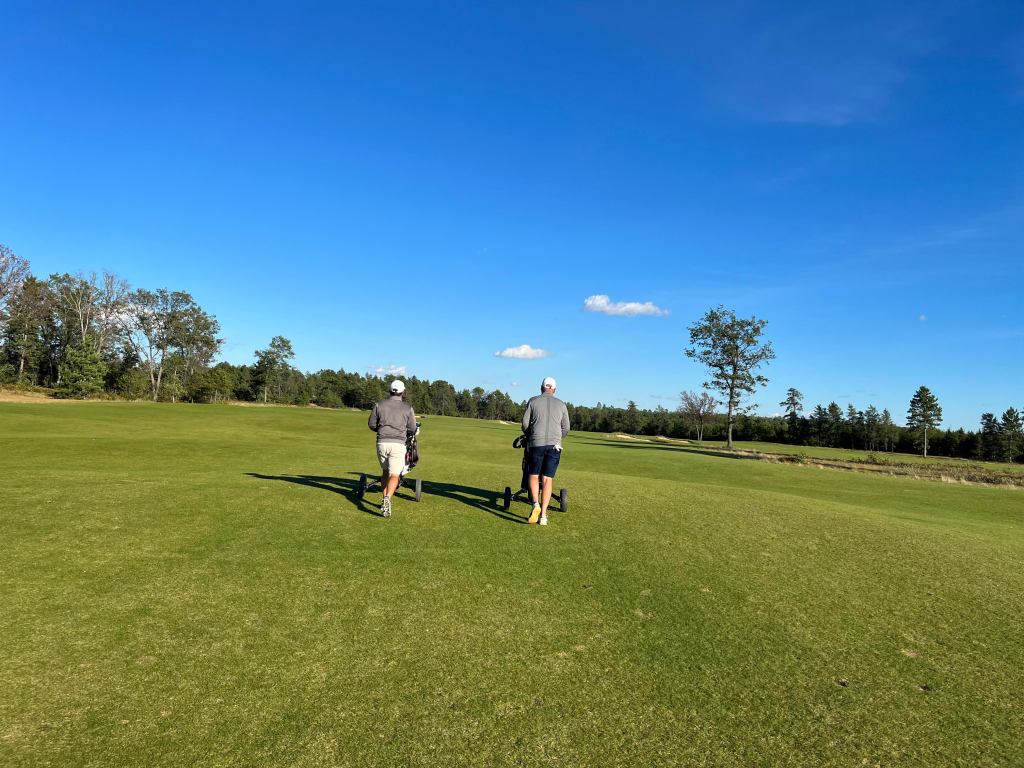
October 29, 2022

Dogfight, Blue Tees

Score: 74

Fairways: 7/13

Greens: 10/18

Putts: 31

18 – [Fairway: 1; Green: 0; Putts: 2; Score: 6] A bit short sided in 2, left side of green to a front left pin. Tried to get too cute with pitch and left myself still short sided. Good second chip but missed 6’. +1 mental, +0.5 putting

1- [F: 1; G: 0; P: 2; S: 5] Poor, uncommitted swing off the tee. Pushed my hybrid way right and had 5i in. +1 mental

2- [F:1; G:1; P:2; S: 4] Well played hole. Hit wedge to ~8’ and missed the putt. +0.25 putting

3- [F:1; G:1; P:2; S: 5] Another good drive. 2nd just short of left greenside trap. Chip was hit too hard or didn’t read the lie correctly. Had ~8’ down the hill and missed putt. +1 short game. Pitch was really simple

4- [G:1; P:1; S:2] Good 7i from top tee box into the wind. About 15’ and made putt. -0.5 putting

5- [F:1; G:1; P:2; S:4] Good drive, miss hit iron that came up in the middle to a back pin. Good 2 putt. +0.25 iron for basically no shot at birdie.

6- [F:1; G:0; P:1; S:4] Good drive with hybrid to center of fairway. Pulled iron shot and missed green. Average chip from a relatively simple spot to about 7’. Made putt. +0.25 iron, +0.25 chip, -0.5 putt.

7- [F:0; G:1; P:1; S:3] Hooked another hybrid on this hole. Got lucky that it came down just in front of the bunker. Wedge was hit behind the hole about 30’ and made the putt. +0.5 wedge/iron, -1 putt

8- [G:0; P: 2; S: 4] Back center pin. Pushed 7i into the right greenside trap leaving an awkward bunker shot.Decent bunker shot to 14’ and missed the putt. +1 for an uncommitted swing on the tee shot.

9- [F:0; G:1; P: 2; S: 5] Heely cut 3w to the backside of the grass bunker. Chunk hooked a 5i over the ditch to left rough. Good wedge from there but shot ran out to 30’ due to lack of spin. Good 2 putt. +0.5 driving, +0.25 Mental

10- [F:0; G:0; P:2; S:5] Pulled 3w left into trees/pine straw. Good shot from there just short of green. Poor chip to 20’ and missed putt. +0.5 mental on uncommitted tee shot. +0.5 chipping

11 – [F:0; G:1; P: 1; S: 4] Drive just slightly right but kicked down the hill into the trees. Punch cut out of the trees just left of green. Hit a good pitch shot that just ran out further than I thought it would but made the putt from 15’. -0.5 putting

12- [G: 1; P:2; S:3] Good 7i to about 10’. Left the putt short right in the heart.

13- [F: 0; G:1; P: 2; S:5] Pulled drive left on the hill again. Good recovery and wedge shot to about 12’ but putt was from an awkward spot with lots of break and down hill. Good 2 putt. +0.25 driving not being able to go for it in 2.

14- [G:0; P:2; S:4] Air mailed the green from 165 with 8i, but it was down wind. Tried to get cheeky with a hybrid but came up short coming down the hill. Missed 15’. I would contribute this to mental, but I’m happy that iron did go long. It shows that the distance is coming back.

15- [F:1; G:0; P:2; S:5] Drive of the day. Had 65 yards to a front pin and chunked a wedge just short of the green. Average chip to 5’ short as I was protecting going on top of the ridge. Missed the putt. + 0.5 chip, +1 iron/wedge

16- [G:0; P:1; S:3] Miss struck an iron that came up a bit short. Nice chip to 4’ and made the putt.

17- [F:0; G:1; P:1; S:3] Heely cut 3w to the right side of the green. Good chip to 12’ and made a down hill slider. Have to make a more committed swing on that tee as I keep hitting it over there. +0.25 mental, -0.25 Putting

Mental+3.5
Putting-2
Short game+2.25
Irons/Wedges+2
Driving+0.75
Total+6.5

What went well- Overall I am happy with the ball striking. It was not where I wanted it to be but it is coming along. Again, I was focused on tempo throughout the round and I noticed that the ball was going a bit farther and that my misses were better. Focusing on this will continue to be an important point moving forward. I was also trying to keep my lower body stable and simply turn which seemed to help the tempo as I was not getting disconnected. I bought some resistance bands to help with feeling this stability. 

What can we get better at- In terms of the different areas of the game I think we keep working on what we’re doing. Balance, Tempo, and Tension focus with some lower body stability and a better pivot. A big area to get better at is the mental side. Making committed swings to defined targets. Clearly stating my intentions on each and every shot. A draw at that tree, a fade off that bunker, etc.. 

Practice Session – 10/21/2022

Warm-up

  • 10 reps squat
  • 10 reps (each side) standing rotations
  • 10 reps (each side) golf posture rotations
  • Chest/shoulder/tricep stretch
  • 10 reps Overhead extensions
  • 10 reps (each side) kneeling hip flexor stretch

Putting

  • Mirror work – 15 minutes
    • Focus on Setup, balance and tempo. Putts hit with eyes closed to determine body movement
  • 3,4,5 by 5 (star drill)
  • 10 Reps leapfrog
  • Notes –
    • Putting with my eyes closed during my mirror work really helped me feel the movement of my body. This helped me gain a sense of stability in my stroke. It also helped to smooth the takeaway out a touch and maintain a better rhythm throughout the strokes. These are feelings I can build upon.
    • 3,4,5 x5 completion time 15:05. Really noticed the effects of tension in this drill. As it would ramp up as I got farther along, I would inevitably miss one and have to start over. Again, the take away and not snatching the putter back is critical
    • Leapfrog scores- 4, 3, 3, 1, 3, 5, 2. Completed 7 rounds due to time. Started with Uphill and then alternated downhill putts.

Short game

  • Trail arm only – 15 minutes
    • Focus on set up and rotation
  • High, low, medium – 15 minutes
    • 3 clubs, 3 trajectories, same hole
  • 6 x 3 (easy, medium, hard)
  • Notes –
    • 15 minutes is too long for trail arm only. How can I better bring that feeling to normal technique? Should it be two shots with 1 arm then 1 shot normal?
    • Again: Balance, Tempo, and Tension. Dial them in
    • Didn’t do 6×3 due to time

Full Swing

  • Wedge leapfrog
  • 5×3 Balance, Tempo, Tension
  • 5×5 52 card pick up (shot shape and trajectory)
  • 5×3 set go drills and building connection
  • 5×3 Balance, Tempo, Tension
  • Wedge leapfrog, 3 sets
  • Notes-
    • Wedge leap frog is an excellent drill to get warmed up. I did better than I thought I would for the first time doing this drill. I only had 2 shots which did not fly past the previous ball. Though the leaps were larger than I would have liked.
    • Balance seems to be in a good spot. I had the ability to hit shots with feet together, one legged, and with eyes closed. It did feel like I had to swing “slower” while doing these shots which helps with tempo.
    • Slowing down the tempo helps me to feel where the club is better and what my body is doing. With the slower tempo contact felt much better, at least more consistent. I believe in my desire to hit the ball farther with the irons, my tempo got overly quick trying to hit it too hard. Which was detrimental to the goal. Slower = Longer.
    • Didn’t do 52 card pick up (forgot my cards), or the ending wedge leap frog due to time.

Sunday October 23, 2022

Progress is not Linear

When we are working on our game it is normal and should be expected that our performance will decrease in the near term. This Sunday I shot 83 from the Black (tips) tees at my home course. Though the score was not what I wanted, there was noticeable progress in other areas. 

During my practice session on Friday, I spent a lot of time exploring and developing balance, tempo, and tension awareness. I tried to bring this awareness to the course on Sunday. The results were promising even though the score wasn’t. It’s important to see the good our work is doing even though results might not be there yet. As such I’m going to do this round review a little bit differently. I’m not going to focus on where I was gaining or losing strokes, but whether the previous practice session was effective. This will help to inform future practice and our process.

My main focus during the round was to maintain good tempo and rhythm, on each and every shot. To help facilitate this I was taking two tempo practice swings behind the ball with my feet together. It is difficult to over swing and get out of rhythm when your feet are so close as your balance is decreased and you risk falling over. I then tried to bring this balance and tempo into the shot and the results were encouraging. The distance I was hitting my irons was greater and the quality of strike felt much better. I even had several approach shots that ended up past pin high. I have really struggled getting shots to the hole over the past couple years so this was encouraging. I wouldn’t say that I was hitting my iron long, but rather I was getting the distance out of them that I believed that I should. Though my proximity wasn’t great, which led to the higher score it was validating to begin to strike my irons consistently. Through more reps the proximity should start to tighten up a bit more and more birdies will be had. 

Similar to my proximity, I struggled with putting mainly due to my speed control early in the round. I was hitting my start lines  but  just hitting the putts too hard. This led to some tentative strokes later in the round and I didn’t really make much all day. Like with my full swing I was again focusing on maintaining a good tempo. This led to me actually putting a better roll on the ball which led to the speed issues. Again this is an area where performance was down for a single day, but in the long run will be beneficial. 

Another benefit I saw while playing was that I could feel what the club and my  body were doing much better on both good and bad swings. Knowing these feelings will help me in the learning process as I continue to make better swings more consistently. Building this base of tempo and balance is critical and soon the scores should begin to drop. 

It is important to look at other metrics besides your score or handicap when working on your game as often short term performance decreases. Actually evaluate the results of the work put in to see if they’re achieving the gains you want. If they are, then eventually the scores and handicap will come down. In the case of balance and tempo for me, I know this is an area in which I need to get better at as shown by the good things that happened in this round. I will continue to focus on these fundamentals as I continue my Process.

Team Tempo

I am lucky these days that I get to play a lot of golf with my brother. We are both obsessed with getting better at the game. One recurring thing that we say to each other, when things are not going well on the golf course or we are about to hit a big shot is “Team Tempo.” This is our way of reminding each other that tempo, and balance for that matter are important fundamental aspects of our golf swings. When our tempo and balance are good we hit good shots, at least serviceable ones. When things start to go sideways often if we just focus on maintaining a good tempo and balance our performance improves.

In his book, Swing Secrets and Lies: 6 Timeless Lessons, Michael Hebron says “It is not possible to reach your potential, or even make much progress, without improving your timing (or tempo) and balance.” That is a pretty big statement for theProcess. Because our goal is to improve, play better, and get more out of our game we must stay focused on tempo and balance.

Think about it, when you are playing well, or in contention at a golf tournament and a bad shot pops up. One that is so uncharacteristic of your performances thus far, it is often the result of a change in tempo or balance. It is not that suddenly you lost your skill level. 

Pia Nilsson and Lynn Marriot, authors of the book Be a Player and founders of Vission54 also place major emphasis on what they call Balance, Tempo, and Tension (BTT) skills. They believe that BTT is the gateway through which we can access our best performance states.

In my description of my swing one of the key elements that I noted was the speed of the take away and backswing. When it becomes too fast then the swing gets disconnected and the body must “find a way” to hit the ball. But if we focus on maintaining good tempo and balance then much of our perceived faults will self correct. Again we look to Hebron, which he says “Unnecessary and unorthodox movements in the golf swing are often compensations for a swing that has moved off center and out of balance. Consequently the only way to stop unwanted actions is to improve balance. Many swing movements golfers would like to improve or eliminate, can only be helped by improving balancing.

It is also important to note that it is impossible to have good balance if your tempo is also off. Therefore, improving balance must also involve improving tempo. Let’s look at some ways we can improve these areas of our game and add to our process.

  • Engage a better sense of the ground by swinging barefoot or on a towel.
  • Hitting shots with your feet together or on one leg.
  • Ramp up and down your tempo. Learn what it feels like to swing the club for 20% to 100% of your tempo.
  • Similarly, ramp up and down tension in your grip, arms, shoulders and body.
  • Practice swinging with your eyes closed. This takes away one of our major senses  for balance, our eyesight. This forces our awareness into our body to maintain balance.

Try to add some of these to your next practice session. Be aware of them during your next round and note the results. My guess is that your good shots and bad shot will both become better.

What is theProcess.Golf

In today’s internet age information is abundant and cheap. But knowledge, wisdom, and understanding are lacking. There is probably no subject that personifies this more than golf. Go to Google or YouTube and you will find thousands of articles and videos claiming to fix your golf game. Additionally, with the invention of launch monitors and 3D motion capture we can measure exactly what the best players in the world do, down to a minute detail. 

But with all the information out there the average player, the weekend warrior is not getting any better. Average handicaps have not gotten any lower despite this abundance of information and the technology available. In many cases, this information can make a player worse by filling their heads with too many swing thoughts. 

I know because I am that regular guy, the weekend warrior. I’ve tried all sorts of different things to “fix” my golf swing. I once had dreams of playing this game for a living but, as they say “life happens.” I still have dreams and belief that I can play this game at a very high level, but the way I have gone about it has not gotten me to where I want to go. So it is time for a different approach.

That’s why I’ve started theProcess.Golf, to re-evaluate and understand what it takes to actually get better at golf. To develop a process that actually leads to progress and document my findings. One thing I know for sure is that the way I’ve practiced in the past is not effective. Overly focused on the technical side and standing on the driving range hitting the same shot over and over does not lead to learning that translates to the golf course, much less competitive golf. Using a swing thought that you saw in some video may provide better results for a shot or even a round or two, but the results are fleeting. Then you move onto the next video and swing thought and start the process all over again. Instant results, fading away, and then searching for the next tip. Always ending back where you started.

As golfers, we spend the majority of our time practicing alone. We may have coaches that we see from time to time but mostly we are on our own. That’s why it’s important to not get caught in the trap of searching for instant fixes time after time. To know what you’re working on and develop a plan to go about it intelligently and in a thoughtful process oriented way. That way, when we do see our coaches again you’ve made the progress necessary and the next piece of the puzzle can be put in and our progress continues. The good news is that the plan doesn’t need to be overly complicated.

My plan is to publish weekly practice plans that will be based on my periodic review of what I believe I need to be working on. Those plans will also include notes and insights from my practice sessions. Another thing I will be doing is post round reviews. I find it very helpful to go back through a round mentally and identify where you are gaining and losing strokes on the golf course. This helps to identify your strengths and weaknesses to inform practice sessions. 

I will also be posting articles about different topics on golf. For example, how we can think better and get the most out of our game on the golf course. This site is to document my journey, and the things that I’m learning about this game. I hope you can learn something from it too. 

Welcome to theProcess.

What I’m working on

One of the things that has held me back I believe has been the lack of structure when I do go to practice. On top of that I have spent too much time moving from swing thought to swing thought and as a result on the golf course I have been playing golf swing, instead of golf. There’s a big difference there as playing golf swing you lose focus on the conditions that the shot calls for. One of my goals with theProcess.golf is to help clarify what it is that I am actually working on. That way I can develop structured practice sessions. 

In the description of my golf swing I identified what I believe are the keys to my golf swing. Those keys should be the basis of what I’m working on and practice should be structured around those keys.

Full swing:

  1. Sitting at a desk all day has limited my flexibility. As a result my setup has gotten sloppy. A proper set up gets your body into an athletic position and primes it to move in the way it should to make a functional golf swing.
  2. Balance, temp, and tension (BTT). When you are off balance, swinging too fast, or you body is too tight this throws your swing off. Your body wants to stay upright despite the fact that it should be hitting the golf ball. If your Balance, tempo, and tension get off then the body attempts to save itself from falling over. Doing BTT work at the beginning and end of each session will help to ensure those parts of the swing get the necessary attention.
  3. Making a fuller more centered turn. A few weeks ago I had the idea to focus on my impact position. This was really eye opening for me in my golf swing as the only thing that matters to the ball is impact. I noticed that in the back swing I was moving off the ball causing me to have to move back to it on the downswing. As a result the club was getting behind me and I was “scooping” at impact. Turning more centered around my body will help me get into the proper impact position. The proper set up combined with good BTTs help to promote a better turn.

Chipping and Pitching:

  1. Set up and BTT are key here as well. 
  2. Trail arm drill. This has been a game changer for me. In the past my arms and hands have been overactive and the body has been under active. This drill helps me to feel the body rotate through while keeping connection. Always something to keep an eye on.
  3. While the trail arm drill has helped thus far, one area that I know I need improvement on is trajectory control around the green. Working on hitting different trajectories, one high, low and medium to the same pin will help me develop more touch around the green.

Putting:

  1. Keeping my head still. A fundamental skill of putting. Should be touched on in every practice session.
  2. When I start putting bad, especially on shorter range putts my setup is usually off. This causes my hands to get over active. 
  3. Speed control. Speed is the most important aspect of putting. You can not determine a line that you want to roll the ball on without determining the speed. Controlling the speed of your putts will help you make more putts.

Non-Technical:

  1. The practice tee is great for learning to swing the club better, but often the improvements in our golf swing don’t translate to the golf course. This is because they are in two different environments and in order to shoot lower scores, we need to replicate the golf course environment a little better. Practicing our routines helps us do this. Your routine should be the one constant on the golf course. It’s the process you go to before every shot and it deserves considerable attention. Because if we do not practice our routine, how can we expect to replicate it on the golf course or in a tournament round.
  2. Similar to practicing our routine, a practice session should not consist of hitting one club to one target. Switch it up, change clubs, change targets, change shot shape. Try to replicate the variability of the golf course. 

Knowing what you’re working on is the first step to developing a practice plan. You will not break through to the next level if you simply go hit a large bucket of balls with no plan. Trust me I’ve tried this, it doesn’t work. If we want to get better at this game, we need a plan and then we need to trust the Process.

My Golf Swing

Often when a golfer sees a video of their swing, they claim that it looks nothing like what it feels like to them. Author and PGA Professional Michael Hebron’s book See and Feel the Inside Move, the Outside suggests that a golfer write down what they think they do in their swing. In order to learn to play more effectively. This is my attempt to describe what I believe occurs in my golf swing:

My golf swing begins with building a proper setup. Tilt forward from the hips not hunched from the shoulders. The knees are flexed straight down so that the hips are over the ankles. The arms hang naturally from the shoulders. The stance should be built wide enough to maintain balance but not too wide to restrict the body’s turn. 

From the proper setup the club is taken back in one piece, with a push from the left shoulder. Keeping flex in the right leg helps to facilitate loading into the right side and prevents over-rotation of the hips which causes the backswing to become disconnected from the body’s turn.

From the takeaway the club begins to set in front of the body with the grip pointed just inside the target line. The set occurs naturally due to the connection of the take away and leverage created at setup. When the golf club fully sets the body simply continues to rotate to the top of the backswing. Fully loading pressure into the inside of the right heel.

A proper backswing should feel like a wound up spring ready to explode forward into the back of the ball. The load in the right leg/foot is pushed off to start the unwinding of the body. Speed is passed from the body to the clubhead through the rotation/unwinding of the energy created and stored in the backswing. The chest remains down and the golf ball is covered. 

There is no stopping or slowing into a full complete finish.

Components that make my golf swing run:

  1. Proper setup to create the leverage to  set the golf club in front of the body. Proper setup also creates the space necessary for the arms and hands.
  2. The speed of the takeaway. Too quick and the hips will likely over rotate and the body becomes disconnected from the arms and hand. 
  3. Loading into the right side allows the proper sequence to occur in the downswing. This also helps to use the big power muscles of the body to create speed instead of trying to create speed with the arms and flipping of the club.